
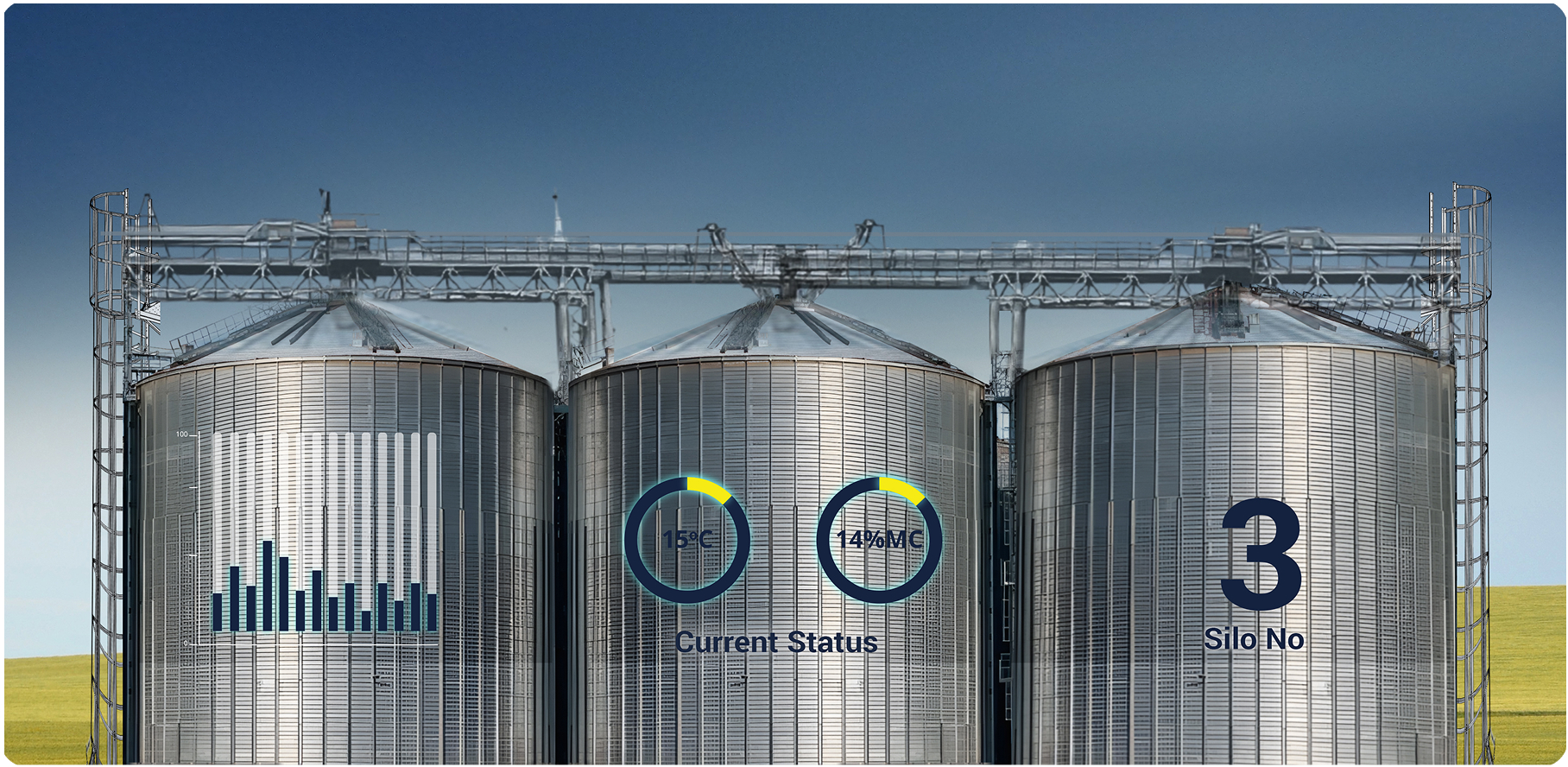
- Why Silos Alone Can Be Dangerous
Many farmers assume that a metal silo is a safe vault for grain. After all, it looks sturdy, airtight, and ready to protect the harvest. But appearances can be deceiving.
Grain, at its core, is thermally vulnerable. Its thermal conductivity is extremely low, around 0.15–0.18 W/mK, compared to steel, which sits at 45.3 W/mK—almost 280 times higher. What does this mean in simple words?
Think of grain as a thick wool sweater. When warm air enters, the heat cannot escape easily. Inside the bulk, small hot pockets form—areas where temperature rises unnoticed. These pockets are invisible to the naked eye but deadly to the crop. They accelerate respiration, create moisture imbalances, and become breeding grounds for insects and fungi.
Even under a shining sun, a metal silo can act as a heat trap, amplifying the problem. This is especially true in tropical, subtropical, or desert climates, where the outside temperature is high and sun radiation warms the metal walls, transferring heat into the grain.
For generations, farmers have observed spoiled grain at the bottom of silos or near the walls, wondering why even after careful drying, losses still occur. The answer is simple: the silo alone cannot manage heat and moisture effectively.
- Awareness Gap: Storage Losses Are Often Ignored
Another challenge is knowledge. Most farmers, millers, and traders focus on production and milling efficiency, not on storage science.
Machinery manufacturers in the food processing industry emphasize better milling performance, higher throughput, and energy efficiency, but rarely educate their customers about what happens after the grain leaves the dryer. Even if a farmer owns the most advanced dryer or the world’s best silo, improper storage can erase the benefits.
Storage losses are silent and sneaky:
- Grain may lose color, aroma, and nutritional value.
- Milling efficiency can drop because damaged kernels grind unevenly.
- The end product suffers, whether it’s flour, rice, or processed food.
Studies show post-harvest losses can reach 20–30% in tropical climates, which is more than the farmer earns for several months of hard work. Without proper temperature and moisture control, the best seeds and machinery alone cannot save the harvest.
- Why Traditional Aeration Isn’t Enough in Tropics
Western pioneers in grain storage often rely on ambient-temperature aeration. These systems are designed to store grain using cool, dry outside air. Automated aeration works well when:
- Relative humidity is below 65%
- Ambient temperature is 6–7°C lower than the grain temperature
Under such conditions, grain can be safely stored without active cooling. But the tropical, desert, and subtropical regions tell a different story.
- High temperatures and high humidity make ambient air unreliable.
- Unpredictable weather due to climate change—storms, sudden rain, heat waves—makes traditional aeration even less effective.
- Grain loaded into silos may gain heat and moisture faster than it can be ventilated, forming the very hot spots that ruin quality.
In short, natural aeration is no longer enough. Farmers and traders are discovering that refrigeration-based cooling is now essential for safe, long-term storage.
- How Grain Coolers Work: The Game-Changer
This is where grain coolers like Svalz GrainVault become the hero of the story. Unlike traditional methods, grain coolers take full control of the grain environment:
- a) Air Generation
- Ambient air is drawn into the machine and cooled to a specific temperature.
- Relative humidity is adjusted automatically to prevent over-drying or condensation.
- For long-term storage, the cooler sets the grain temperature around 10°C, which slows respiration, stops insects, and prevents mold.
- b) Controlled Airflow
- Conditioned air is blown into the silo through pressurized ducts at the base.
- The system ensures air flows evenly across the silo floor, eliminating the risk of channeling, where some areas get cooled while others remain hot.
- c) Slow Upward Movement
- Air rises through the grain column very slowly, around 0.01 m/s, giving enough time for heat and moisture exchange.
- Each kernel, from bottom to top, comes in contact with the cool, stable air.
- d) Heat & Moisture Exchange
- Grain kernels are hygroscopic, meaning they can absorb or release moisture.
- Cool air passing through the grain picks up heat and some moisture, lowering the grain temperature gradually.
- This partial drying stabilizes the grain and prevents conditions favorable to insects or fungi.
- e) Continuous Cycle
- Warm, moisture-laden air exits through roof vents, and the cooler continues to supply conditioned air.
- The cycle runs uninterrupted, regardless of rain, heat, humidity, or storms.
- f) Automation & Reliability
- The operator simply turns on the Svalz GrainVault.
- The system automatically monitors and adjusts temperature and RH until the grain reaches safe storage conditions.
- No manual aeration, fumigation, or chemicals are required.
In other words, the grain cooler does the hard work while the farmer sleeps easy.
- Why Grain Coolers Are a Game-Changer
Grain coolers solve multiple storage problems simultaneously:
- Heat Pocket Elimination – No more unseen hot spots in the bulk.
- Moisture Stabilization – Prevents condensation, mold, and insect activity.
- Continuous Operation – Works through weather extremes and global warming unpredictability.
- Cost-Effective – Less expensive than chemical treatments or repeated fumigation.
- High Reliability – Predictable results for short-term or long-term storage.
This is not just technology; it is peace of mind for the farmer, miller, or trader.
- A Real-Life Farmer Story 🌾
In Tamil Nadu, stored 3,000 tons of Paddy in conventional silos. Despite careful drying, hot spots developed within a week, causing anxiety for the farmers.
They installed a Svalz GrainVault cooler, set at 15°C, and ran it for 7 days. The results were dramatic:
- Uniform grain temperature throughout the silo
- Insects disappeared
- Moisture stabilized
- Six months later, the maize retained its fresh color, aroma, and quality
The cooperative not only saved the crop but also received higher market prices, because buyers recognized the quality difference.
- The Future of Grain Storage
Grain coolers represent a new era of post-harvest technology. With global warming, unpredictable rainfall, and extreme temperatures, relying on traditional silos or ambient aeration is no longer safe.
- Farmers gain peace of mind and protect their livelihood.
- Millers achieve better milling efficiency and consistent product quality.
- Traders reduce losses and improve profit margins.
Grain cooling technology is not an optional upgrade—it is essential for modern grain storage, ensuring the months of effort in the field are preserved in the silo.
Conclusion
The story is clear: from the field to the silo, every step matters, but storage is often the most overlooked yet critical step.
- Metal silos alone cannot prevent heat pockets.
- Farmers often underestimate storage losses.
- Traditional aeration fails in tropical or unpredictable climates.
Grain coolers, such as the Svalz GrainVault, take full control of the storage environment, automatically managing temperature and moisture, providing reliable, long-term protection for grains without chemicals or manual intervention.
It is truly a game-changer—turning silos from passive containers into active vaults of preservation, giving farmers, millers, and traders confidence that their harvest is safe, high-quality, and ready for the market.
In short: Grain coolers don’t just store grain—they protect dreams.