
Grain is one of the most valuable commodities in the world, but it is also one of the most vulnerable. Once harvested, it continues to respire — producing heat and moisture inside storage silos. If left uncontrolled, this leads to hot spots, insect infestations, mold growth, and spoilage.
Drying grain reduces moisture, but even dried grain is usually warm when loaded into a metal silo. Without immediate cooling, conditions inside the bulk become unstable. This is where the grain cooler plays a vital role.
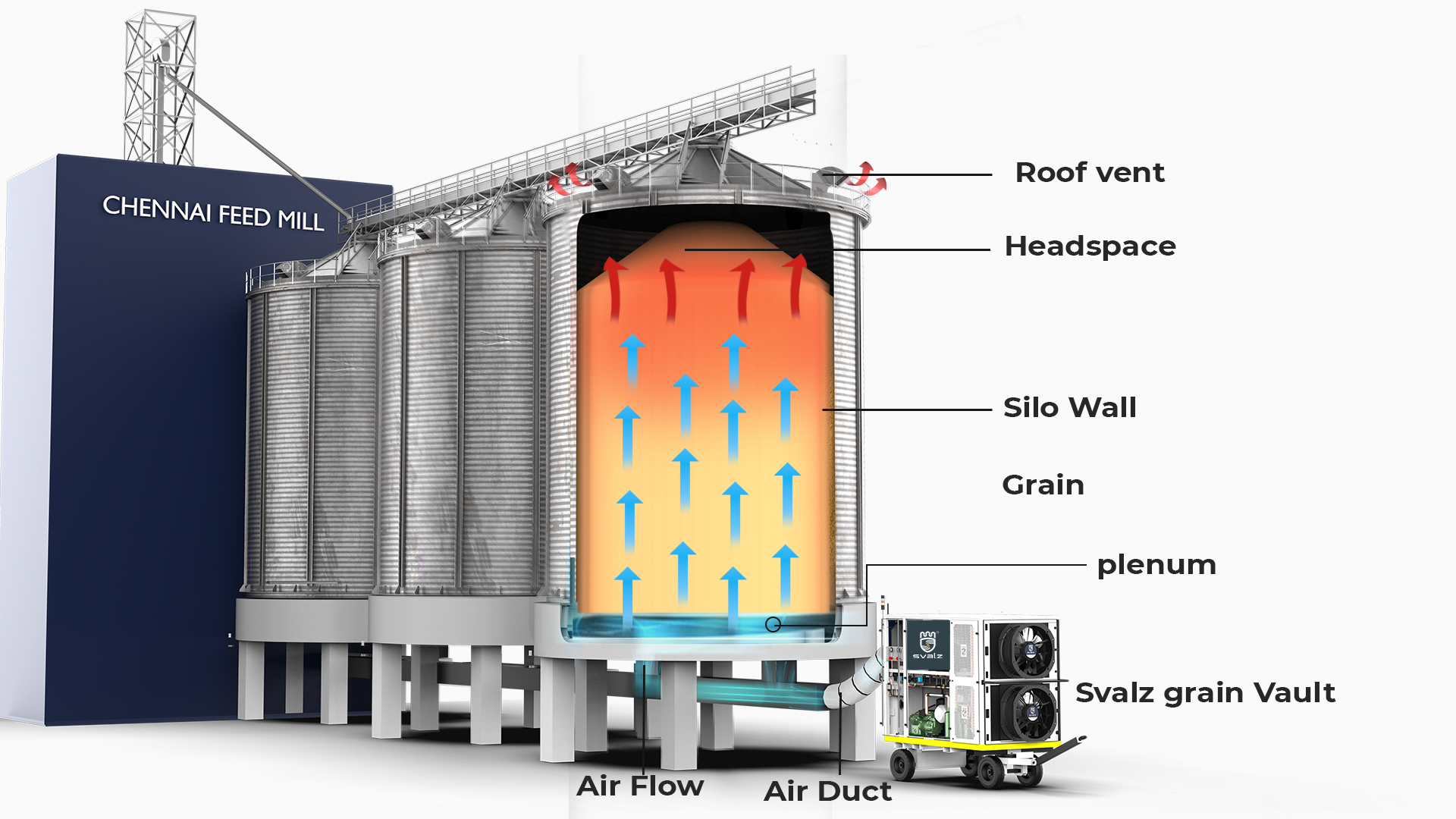
A grain cooler is essentially a refrigeration-based aeration machine that supplies cold, conditioned air into silos at controlled velocity, temperature, and relative humidity (RH). Over a period of one to two weeks, this air gradually reduces the grain temperature, stabilizes moisture content, and ensures safe storage for months or years.
In this article, we will look step by step at how a grain cooler works, the science behind it, and why it is more reliable than conventional aeration systems.
1. Air Generation – Creating Cold, Conditioned Air
The process begins with the intake of ambient air into the grain cooler. This air is:
- Cooled: Passed through a refrigeration system (compressor, condenser, evaporator) to bring down its temperature.
- Conditioned: Adjusted to maintain a specific relative humidity (RH) level to avoid over-drying or adding moisture.
For example:
- In short-term storage, the cooler may reduce air to 15–18°C.
- In long-term storage, the cooler produces air at around 10°C, with RH automatically balanced to prevent cracking or over-drying of kernels.
The result is cold, stable, and slightly dehumidified air, ready to be blown into the silo.
2. Airflow into the Silo – Pressurized Distribution
The conditioned air is then forced into the silo through pressurized ducts or an aeration floor at the base.
Here, static pressure is carefully managed so that:
- Air spreads evenly across the entire silo floor area.
- Channeling (air taking the easiest path upward) is avoided.
- Every kernel in the bulk eventually comes in contact with conditioned air.
Without this controlled pressurization, some zones of the silo would remain untreated, leading to hot spots.
3. Slow Upward Movement – Controlled Air Velocity
Unlike ventilation fans, which operate at high speeds, grain coolers push air upward slowly, typically at 0.03 m/s.
Why so slow?
- At low velocity, air has enough residence time in the grain column to absorb heat and moisture effectively.
- Fast-moving air would pass through too quickly, reducing heat exchange efficiency.
This slow upward movement ensures uniform cooling from the bottom to the top of the silo.
4. Heat & Moisture Exchange – The Heart of Cooling
As the conditioned air rises through the grain mass, two processes occur simultaneously:
- Heat Transfer
- Warm kernels transfer heat to the cooler air.
- Grain temperature decreases gradually until equilibrium is reached.
- Mass Transfer (Moisture Movement)
- Grain kernels are hygroscopic — they can absorb or release water vapor.
- If the passing air has a lower vapor pressure (dryer air), kernels release moisture.
- This leads to partial drying in addition to cooling.
Example: Corn Storage
- Corn kernels have a permeable outer shell.
- When 10°C, 65% RH air passes over warm corn at 30°C, the kernels lose both heat and a small amount of moisture.
- Result: Corn cools, stabilizes, and resists mold and insect damage.
By the time the air exits the grain layer, it is warmer and more humid, having picked up the heat and moisture released by the grain.
5. Air Exit – Warm Air Leaves Through Vents
Finally, the moisture-laden, warm air exits through roof vents at the top of the silo.
This continuous cycle — cool air in, warm air out — repeats for 7–14 days, depending on silo size and grain type, until the entire grain mass reaches the desired safe temperature.
7. Scientific Principles Behind Grain Cooling
The entire process relies on fundamental physics:
- Heat Transfer (Thermodynamics)
- Heat flows from the warmer body (grain) to the cooler body (air) until both reach equilibrium.
- Mass Transfer (Moisture Migration)
- Driven by differences in vapor pressure between grain moisture and conditioned air.
- Grain releases or absorbs water vapor until balance is reached.
- Airflow Dynamics (Fluid Mechanics)
- Static pressure distribution ensures air moves through the entire bulk, not just through low-resistance channels.
Uniform flow = uniform cooling.
8. A Practical Example
Let’s calculate for a 10,000-ton wheat silo:
- Initial grain temperature: 30°C
- Target temperature: 10°C
- Air velocity: 0.01 to 0.03 m/s
- Cooling duration: 9–12 days
During this period:
- Respiration slows down by nearly 80%.
- Mold growth is halted.
- Insect reproduction drops to near zero.
The entire bulk achieves stable, uniform conditions, turning a high-risk storage situation into a safe, long-term preservation system.
9. Farmer Case Study 🌾
A cooperative in Tamil Nadu stored 3,000 tons of maize in silos. Despite drying, hot spots formed within a week due to high respiration.
They installed a grain cooler set at 10°C and ran it continuously for 12 days. The results:
- Grain stabilized with uniform temperature.
- Insects disappeared.
- Six months later, the maize retained its fresh color, aroma, and quality.
The cooperative not only saved its crop but also gained a higher market price because the grain quality remained premium.
10. Summary – The Working Cycle of a Grain Cooler
To put it simply:
- Air Generation → Ambient air is cooled and conditioned.
- Airflow into Silo → Pressurized ducts distribute air evenly.
- Slow Upward Movement → Low-velocity airflow moves through the grain column.
- Heat & Moisture Exchange → Grain releases heat and some moisture.
- Air Exit → Warm, moist air leaves through vents.
- Stabilization → Grain reaches safe temperature and equilibrium in 7–14 days.
This controlled cycle makes grain coolers a scientifically proven solution for safe, long-term storage