
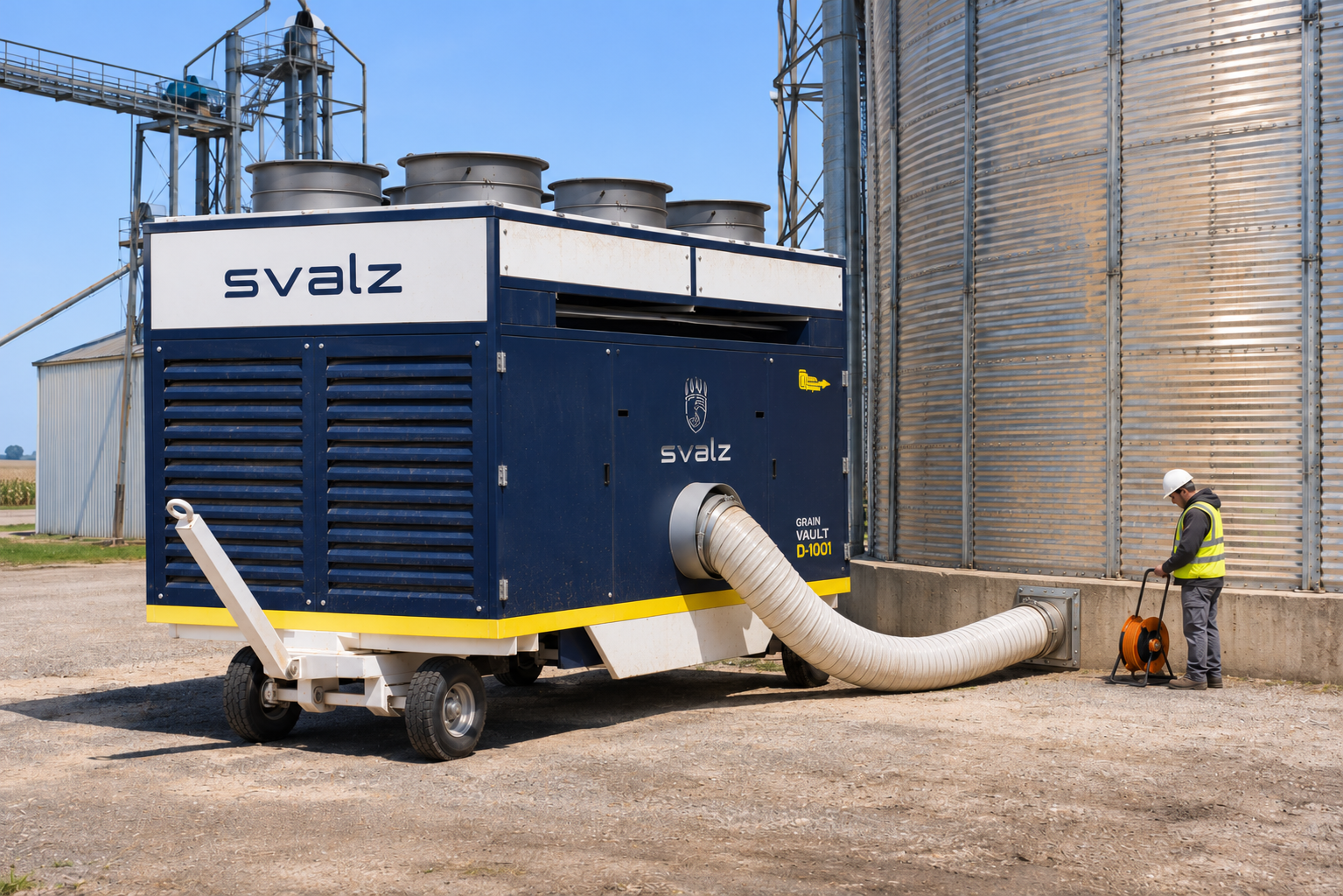
A hot spot is a pocket in the grain where conditions drift away from the rest of the silo. SVALZ says its uniform, controlled airflow is designed to prevent them. This article explains how the airflow works and why consistency across the whole silo matters.
In This Article
- What SVALZ Says Hot Spots Are Linked To
- Heat and Moisture
- Uniform, Controlled Airflow
- The Cooling Front
- Controls and Sensors
- Why Large Silos Are Harder
- Monitoring
- Support
Conclusion: Even Conditions Throughout the Silo
Frequently Asked Questions
1. What SVALZ Says Hot Spots Are Linked To
The SVALZ FAQ says GrainVault’s airflow prevents hot spots, mold and insect growth.
They are named together as the outcomes uneven conditions can cause.
SVALZ treats them as the main targets of cooling.
2. Heat and Moisture
SVALZ points out that grain often loses quality because of heat and moisture.
The cooling treats both by cooling and dehumidifying the air.
This is how the system aims to remove the conditions hot spots depend on.
3. Uniform, Controlled Airflow
SVALZ says refrigeration-based cooling delivers uniform, controlled airflow.
The aim is for the whole grain mass to receive the same treated air.
SVALZ says results stay consistent even in large silos.
4. The Cooling Front
Cold, dry air moves upward, extracting heat and moisture layer by layer.
This forms what SVALZ calls a cooling front.
It advances until the entire bulk reaches a uniform temperature.
5. Controls and Sensors
Intelligent controls monitor air temperature, humidity and grain sensors.
SVALZ says they adjust the cooling process automatically.
At target temperature, the unit switches to standby.
6. Why Large Silos Are Harder
SVALZ says its approach gives consistent results even in large silos.
Models range from up to 500 tons to up to 18,000 tons.
The same principle applies across that range.
7. Monitoring
Optional remote monitoring lets operators track conditions and receive instant alerts.
The Milling MEA report notes IoT-enabled sensors for real-time monitoring of temperature and system health.
Monitoring helps operators follow the silo after cooling.
8. Support
A quarterly inspection, once every 3 months, is generally sufficient.
The GrainVault 365 package provides remote guidance and expert advice.
Manuals, warranty registration and a dealer locator are listed on the SVALZ website.
Conclusion:Even Conditions Throughout the Silo
SVALZ’s answer to hot spots is even treatment: filtered, cooled, dehumidified air moving through the grain as a cooling front until the whole bulk is at a uniform temperature.
Frequently Asked Questions
1. What does uniform airflow prevent?
The SVALZ FAQ says it prevents hot spots, mold and insect growth.
2. What is a cooling front?
SVALZ’s term for the advancing zone of cold, dry air that extracts heat and moisture layer by layer.
3. Does it work in large silos?
SVALZ says results stay consistent even in large silos.
4. What do the controls monitor?
Air temperature, humidity and grain sensors.
5. What happens at the target temperature?
The unit switches to standby with minimal energy use.