
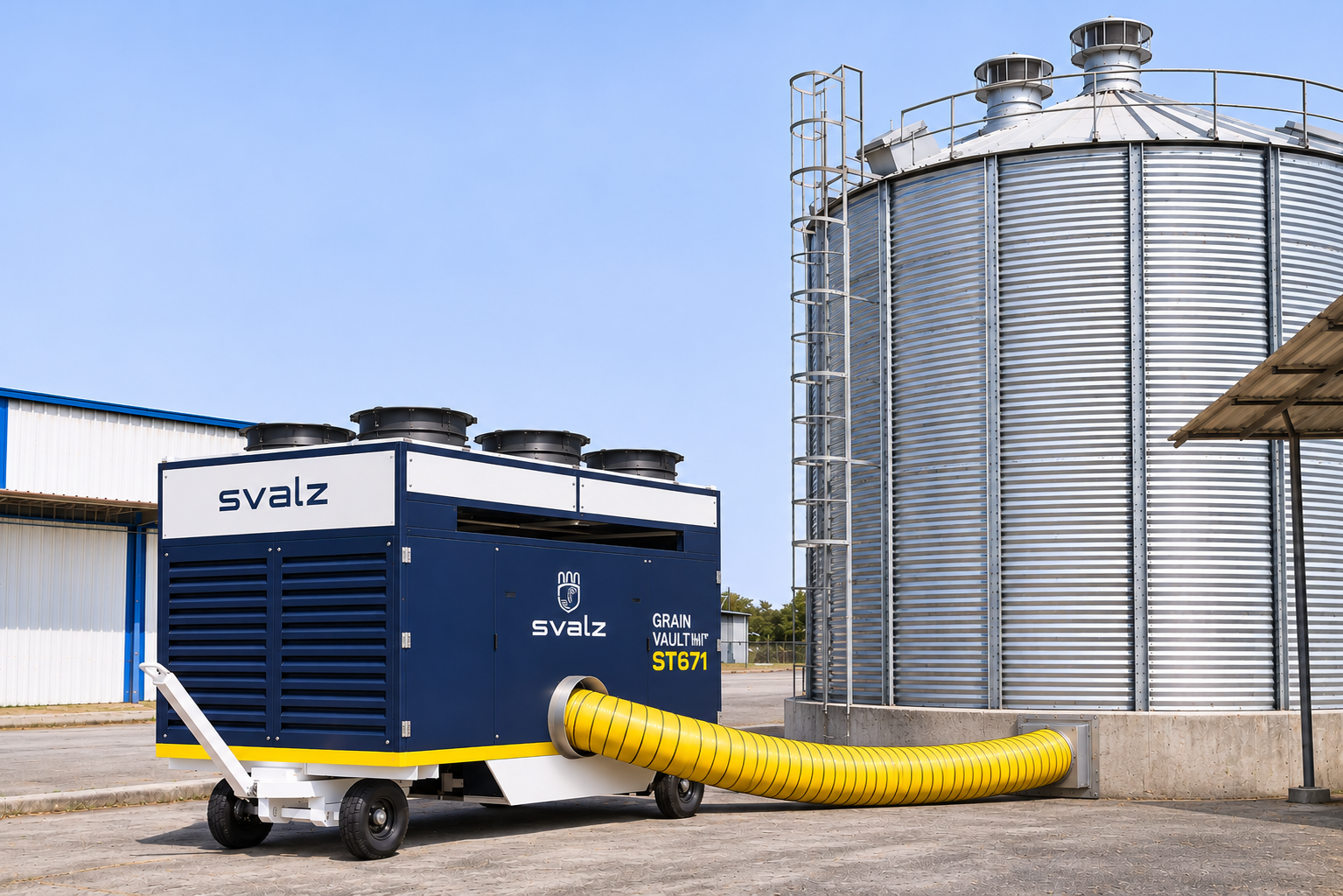
How air moves through a silo decides how evenly the grain is cooled. SVALZ describes a design in which cooled, dehumidified air enters the grain through the silo’s existing aeration ducts and advances as a cooling front. This article explains that airflow path, step by step.
In This Article
- Why Airflow Matters
- Air In and Filtered
- Cooled and Dehumidified
- Using the Existing Ducts
- The Cooling Front
- Controls Behind the Airflow
- Dust and Airflow
- Sizes and Support
Conclusion: A Clear Path for Cooled Air
Frequently Asked Questions
1. Why Airflow Matters
The SVALZ FAQ says GrainVault delivers uniform, controlled airflow that prevents hot spots, mold and insect growth.
Even delivery is what lets the whole silo be treated, not just part of it.
SVALZ says results stay consistent even in large silos.
2. Air In and Filtered
The cycle begins when ambient air is drawn into the machine.
SVALZ says the air is filtered before anything else happens.
Filtration protects the refrigeration coil that follows.
3. Cooled and Dehumidified
The filtered air passes across a refrigeration coil.
There it is cooled and dehumidified.
The air leaves the machine at a lower temperature and with controlled humidity.
4. Using the Existing Ducts
SVALZ says the conditioned air is gently pushed through the grain mass via the existing aeration ducts of the silo or warehouse floor.
The machine therefore connects to what the storage already has.
SVALZ calls the principle non-invasive precision.
5. The Cooling Front
As cold, dry air moves upward, it extracts heat and moisture from the grain, layer by layer.
SVALZ calls this advancing zone a cooling front.
The front advances gradually until the entire bulk reaches a uniform temperature.
6. Controls Behind the Airflow
SVALZ says intelligent controls monitor air temperature, humidity and grain sensors, automatically adjusting the cooling process.
Once the grain reaches target temperature, the unit switches to standby.
EC fans and an electronic expansion valve support efficient airflow.
7. Dust and Airflow
SVALZ says its coil and fin spacing is the widest in the industry, designed to handle dust load without choking airflow.
Periodic cleaning of filters and coils keeps airflow strong.
Clean filters also lower energy consumption.
8. Sizes and Support
Models run from up to 500 tons to up to 18,000 tons.
Manuals, warranty registration and a dealer locator are listed on the SVALZ website.
The GrainVault 365 package adds remote guidance and expert advice.
Conclusion: A Clear Path for Cooled Air
SVALZ’s airflow path is simple: filter, cool and dry the air, send it through the existing ducts, and let the cooling front move up until the whole bulk is at a uniform temperature.
Frequently Asked Questions
1. Does GrainVault need new ducting?
SVALZ says the conditioned air is pushed through the grain via the existing aeration ducts of the silo or warehouse floor.
2. What is the cooling front?
It is SVALZ’s term for the advancing zone of cold, dry air that extracts heat and moisture layer by layer.
3. What does uniform airflow prevent?
The SVALZ FAQ says it prevents hot spots, mold and insect growth.
4. Is the air filtered?
Yes. Ambient air is drawn in and filtered before cooling.
5. What happens at the target temperature?
The unit switches to standby, maintaining equilibrium with minimal energy use.