Mold and the toxins it can produce are among the biggest risks in grain storage. SVALZ and a Milling MEA report on its launch describe how temperature and moisture drive that risk and how GrainVault responds. This article summarizes what has been published, without adding claims beyond it.
In This Article
- The Risk
- Hidden Until Late
- Heat and Moisture
- Why Ambient Aeration Falls Short
- Temperature Management in Practice
- Halting the Spoilage Cycle
- Chemical-Free
- Monitoring and Support
Conclusion: Stopping the Cycle Early
Frequently Asked Questions
1. The Risk
The Milling MEA report says that when moisture content surpasses 13.5 percent, it accelerates biological processes within silos.
These processes foster fungal growth and hazardous toxins, including aflatoxins and fumonisins.
The report says they compromise food safety and nutritional integrity.
2. Hidden Until Late
The report notes the damage is often undetected until extensive degradation has occurred.
This is why SVALZ focuses on prevention.
The SVALZ FAQ says GrainVault prevents hot spots, mold and insect growth.
3. Heat and Moisture
SVALZ says grain often loses quality in storage because of heat and moisture.
GrainVault addresses both by cooling and dehumidifying the air.
Controlled temperature and humidity are central to its design.
4. Why Ambient Aeration Falls Short
The report states that conventional ambient aeration is inadequate in countering temperature elevations under humid conditions.
It links this to mold development and enzymatic degradation.
SVALZ says traditional aeration depends on ambient weather.
5. Temperature Management in Practice
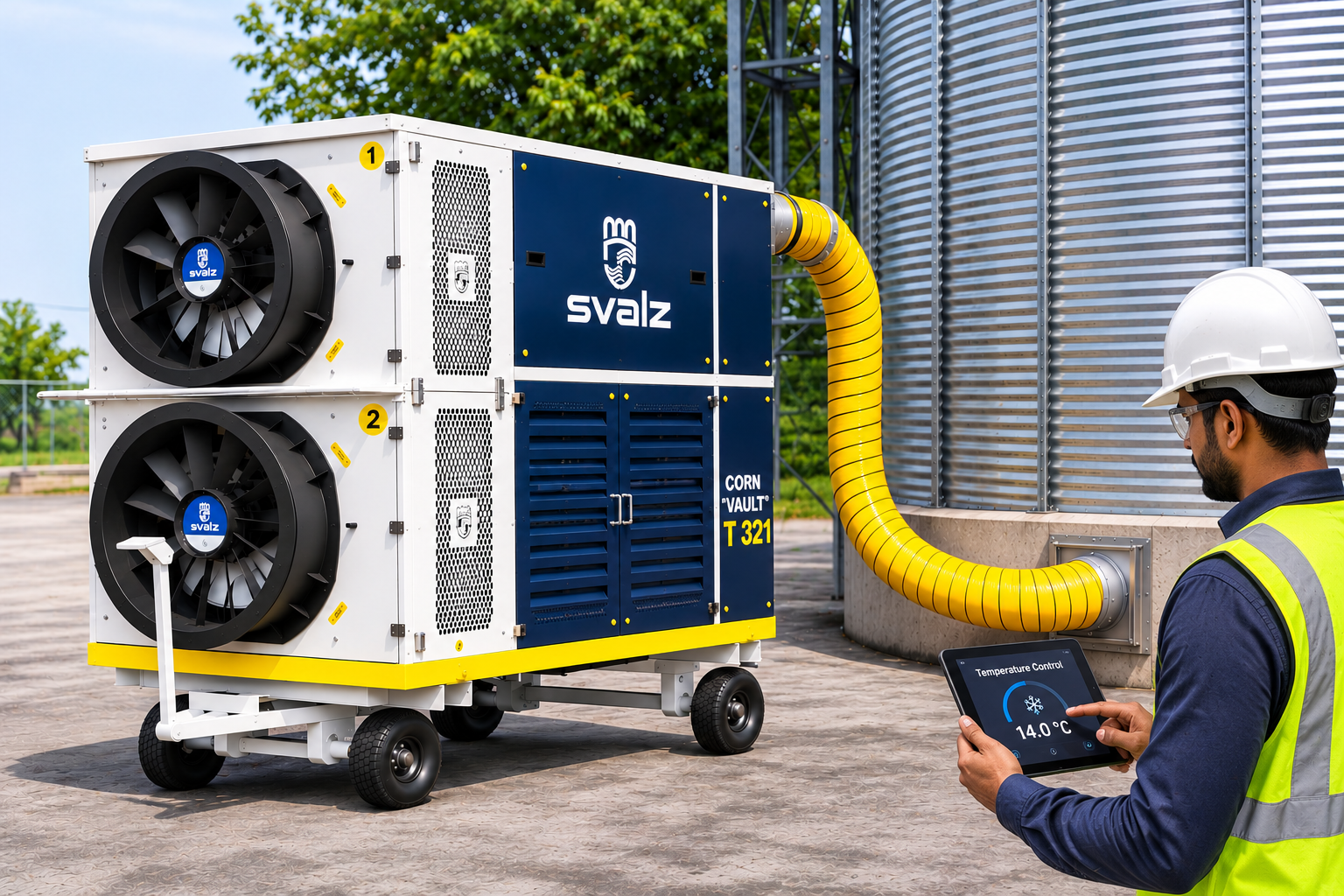
SVALZ says air is drawn in, filtered, cooled and dehumidified.
The conditioned air moves through the grain in a cooling front until the whole bulk is at a uniform temperature.
Controls monitor air temperature, humidity and grain sensors and adjust automatically.
6. Halting the Spoilage Cycle
In the report, SVALZ’s CTO Jagannathan says the aim goes beyond lowering temperature to halting the entire spoilage cycle.
He describes the ability to prevent mold, toxins and nutritional decline even in high-humidity, sulphur-heavy environments.
He adds that a truly stable silo is a safe silo.
7. Chemical-Free
SVALZ describes advanced, chemical-free grain preservation.
The protection comes from treated air, not from anything added to the grain.
This applies across the GrainVault range.
8. Monitoring and Support
Optional remote monitoring lets operators track conditions and receive instant alerts.
The Milling MEA report notes IoT-enabled sensors for real-time monitoring of temperature and system health.
The GrainVault 365 package provides year-round guidance.
Conclusion:
Conclusion:Stopping the Cycle Early
According to SVALZ and Milling MEA, mold and toxins follow heat and moisture, and the best response is to control both. GrainVault aims to stop the cycle before it starts.
Frequently Asked Questions
1. What moisture level does Milling MEA mention?
The report says moisture above 13.5 percent accelerates biological processes in silos.
2. Which toxins does it name?
Aflatoxins and fumonisins.
3. How does GrainVault help prevent mold?
The SVALZ FAQ says its uniform, controlled airflow prevents hot spots, mold and insect growth.
4. Does it use chemicals?
No. SVALZ describes chemical-free grain preservation.
5. Can conditions be monitored remotely?
Yes. Optional remote monitoring is available, with instant alerts.