
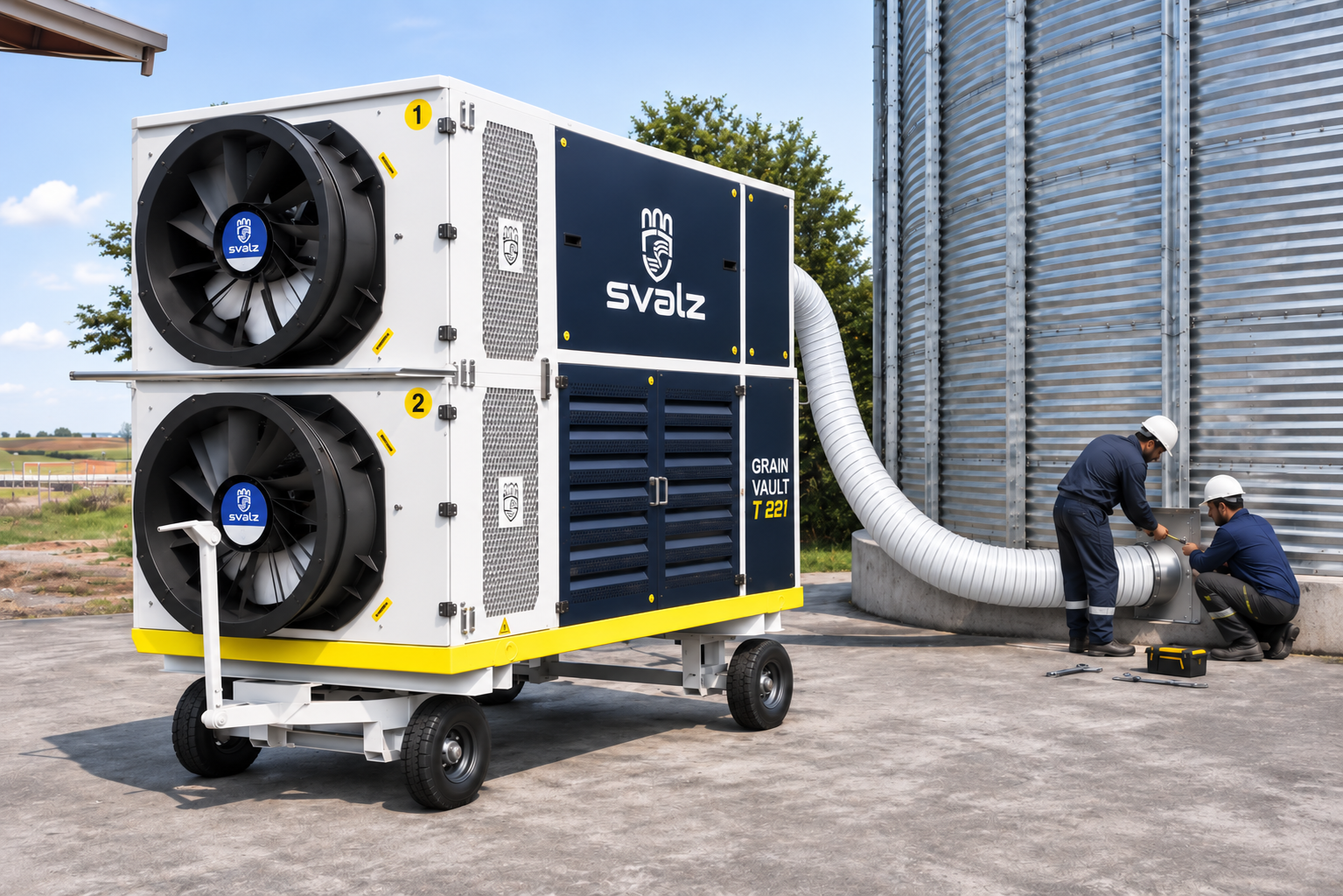
Before a cooler can protect grain, it has to be connected to the silo. SVALZ describes a simple connection principle: the unit sends cooled air through the silo’s existing aeration ducts. This article explains what SVALZ has published about connection, power ratings and support, and where to find the details SVALZ keeps in its manuals.
In This Article
- The Connection Principle
- What the Machine Does Once Connected
- Power Ratings by Model
- Matching a Model to the Storage
- Components
- First Weeks of Operation
- Manuals and Warranty
- Guidance and Monitoring
Conclusion: Connected to What You Already Have
Frequently Asked Questions
1. The Connection Principle
SVALZ says conditioned air is gently pushed through the grain mass via the existing aeration ducts of the silo or warehouse floor.
The machine therefore works with the storage structure already in place.
SVALZ calls its design principle non-invasive precision.
2. What the Machine Does Once Connected
Ambient air is drawn in and filtered, then cooled and dehumidified across a refrigeration coil.
The conditioned air moves through the grain in a cooling front.
Intelligent controls then adjust the process automatically.
3. Power Ratings by Model
SVALZ lists a power rating for models across its range.
Examples: the T-71 at 30 kW, the T-221 at 105 kW, the T-471 at 225 kW and the T-1101 at 470 kW.
The E series is listed by power: the E-91 at 20 kW up to the E-521 at 135 kW.
4. Matching a Model to the Storage
Capacity ratings run from up to 500 tons to up to 18,000 tons.
SVALZ says models are tailored to different storage capacities, from small mills to large commercial silos.
The products page lists the ratings for each model.
5. Components
SVALZ names compressors from Bitzer or Bock, blowers from Ziehl-Abegg and control systems from Danfoss.
Every unit uses low-noise EC fans.
Parts are serviceable worldwide through authorized local networks.
6. First Weeks of Operation
The maintenance guide says a cooler operates for about 2 to 3 months to bring the grain temperature down.
After that, it rests while the grain stays cold.
A quarterly inspection is generally sufficient.
7. Manuals and Warranty
The SVALZ website lists manuals for each machine.
Warranty registration is available through the contact page.
A dealer locator helps customers find a local contact.
8. Guidance and Monitoring
The GrainVault 365 package provides remote guidance, operational assistance and expert advice.
Optional remote monitoring lets operators track conditions and receive alerts.
For site-specific requirements, SVALZ directs customers to its team through the contact page.
Conclusion:Connected to What You Already Have
GrainVault is designed to work through a silo’s existing aeration ducts. For model ratings, manuals and site-specific questions, SVALZ points customers to its products page, manuals and contact team.
Frequently Asked Questions
1. Does GrainVault need new ducts?
SVALZ says conditioned air is pushed through the grain via the existing aeration ducts of the silo or warehouse floor.
2. Where can I find a model’s power rating?
SVALZ lists power ratings for models on its products page, for example 30 kW for the T-71 and 470 kW for the T-1101.
3. Where are the manuals?
The SVALZ website lists manuals for each machine.
4. How do I register the warranty?
SVALZ offers warranty registration through its contact page.
5. Does SVALZ help after installation?
Yes. The GrainVault 365 package provides remote guidance, operational assistance and expert advice, and a dealer locator is available.