
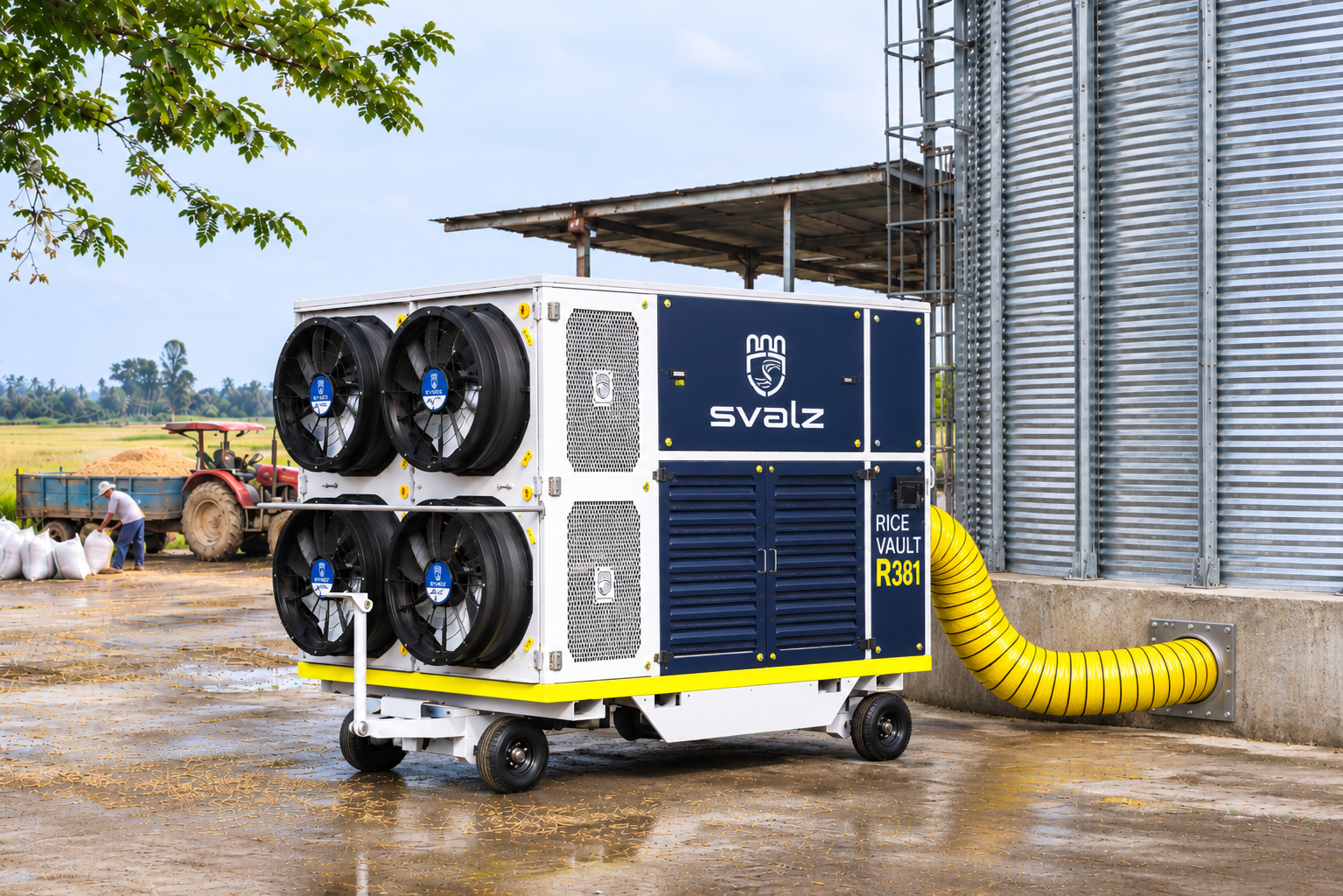
Paddy has to hold its quality from harvest until it reaches the mill. SVALZ describes a cooling approach in which the grain stays cold for months after a short cooling period, and it backs rice storage with a Rice Vault family and paddy case studies. This article follows that story from harvest onward.
In This Article
- The Challenge After Harvest
- Cooling the Paddy
- Cold That Lasts
- A Miller’s Year-Round View
- Six Paddy Case Studies
- Rice Vault Models
- Built for the Long Term
- Guidance Through the Year
Conclusion: Quality That Lasts Past Harvest
Frequently Asked Questions
1. The Challenge After Harvest
SVALZ points out that grain often loses quality in storage because of heat and moisture.
Maharajha, founder of Maharajha Rice Mills, says post-harvest loss was his biggest challenge before GrainVault.
The concern is common to any miller holding paddy.
2. Cooling the Paddy
SVALZ explains that GrainVault draws in ambient air, filters it, then cools and dehumidifies it across a refrigeration coil.
The conditioned air is pushed through the grain, extracting heat and moisture layer by layer.
The company says the result is reduced biological activity and slower insect growth.
3. Cold That Lasts
The maintenance guide says a cooler operates for about 2 to 3 months to bring grain temperature down.
After that it rests, because the cooled grain stays cold for months on its own.
This is how SVALZ describes holding grain through storage without running the machine continuously.
4. A Miller’s Year-Round View
Maharajha says that with GrainVault his yields stay secure and his profits are protected year-round.
His comment is one of three customer testimonials on the SVALZ homepage.
It reflects a full-season view of paddy storage.
5. Six Paddy Case Studies
The SVALZ website features six case studies on paddy: two from Tamil Nadu, and one each from Karnataka, Nepal, Telangana and Andhra Pradesh.
SVALZ presents them as real-world stories of farmers and storage operators transforming their harvests.
They show paddy storage across several regions.
6. Rice Vault Models
The Rice Vault family is the R series: the R-321 (up to 6,000 tons), plus the R-381 and R-300.
For humid regions, the Tropic Tiger T series runs from 500 up to 18,000 tons.
Full details are on the SVALZ products page.
7. Built for the Long Term
The maintenance guide says units are engineered to last 8 to 10 years under real working conditions.
SVALZ describes corrosion-resistant coatings, stainless steel in wet areas and anti-corrosion coatings on coils.
A quarterly inspection is generally sufficient.
8. Guidance Through the Year
The GrainVault 365 package provides remote guidance, operational assistance and expert advice throughout the year.
SVALZ says continuous monitoring and technical support help teams learn faster.
Optional remote monitoring adds real-time tracking and instant alerts.
Conclusion:Quality That Lasts Past Harvest
SVALZ’s approach is to cool paddy once, let it hold its cold for months, and support the miller with monitoring and guidance throughout the year.
Frequently Asked Questions
1. How long does the cooled grain stay cold?
SVALZ says the cooled grain stays cold for months on its own after the cooler runs for about 2 to 3 months.
2. Does SVALZ have paddy case studies?
Yes. The website features six, from Tamil Nadu (two), Karnataka, Nepal, Telangana and Andhra Pradesh.
3. Which models are for rice?
The Rice Vault R series: the R-300, R-321 (up to 6,000 tons) and R-381.
4. What does a rice miller say about GrainVault?
Maharajha of Maharajha Rice Mills says yields stay secure and profits are protected year-round.
5. What year-round support is available?
The GrainVault 365 package provides remote guidance, operational assistance and expert advice, and optional remote monitoring is available.